
Most gym retention strategies start too late.
They wait until a member has stopped attending, become disengaged, or is already close to cancelling. At that point, the relationship may already be weak. The member may feel embarrassed about not coming in, unsure how to restart, or simply disconnected from the reasons they joined in the first place.
But members rarely leave overnight. More often, they drift. Visit frequency falls. Routines are disrupted. Confidence drops. The gym becomes less connected to everyday life. Then, eventually, the monthly dues start to feel like poor value and the member reaches a tipping point.
This is where gyms need a better model of retention. Not just more automated messages. Not just more staff contact. But a joined-up system in which AI and fitness staff work together.
That model could be thought of as the Human – AI Retention Loop.
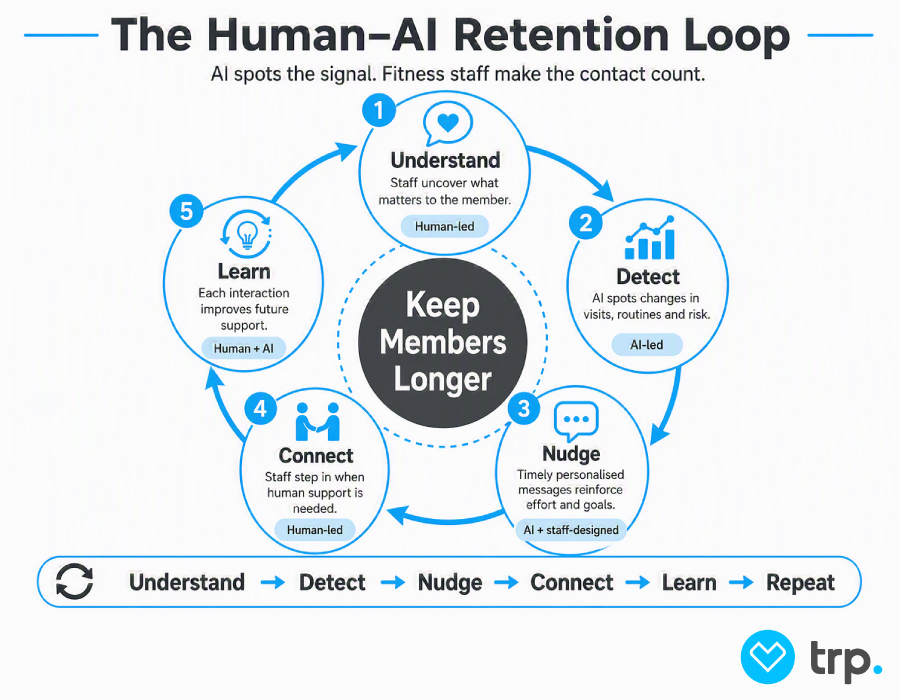
The loop has five stages: staff understand what matters to the member; AI detects changes in behaviour; personalised nudges reconnect members with their own reasons for attending; staff step in when human support is needed; and each interaction helps the system learn. The aim is simple: to spot drift earlier, respond more personally, and help members continue to see value in their membership.
1. Retention starts with understanding the person
The first stage of the loop is not data. It is understanding.
At the outset of a membership, skilled fitness staff can do something that technology cannot do well on its own: they can have a real conversation. They can help members explore why going to the gym matters to them – what was important enough to make them join the gym now?
Not just the surface goal – “lose weight”, “tone up”, “get fitter” – but the deeper reason behind it.
A member might want more energy for family life. They might want to feel more confident. They might want to manage stress, feel stronger after illness, stay independent, improve their health, or regain a sense of control.
These reasons matter because they are often what sustain behaviour when motivation dips. If exercise is only connected to a vague fitness goal, it can quickly lose meaning. But if it is connected to something the member values, attendance becomes more personally important.
This is where fitness staff create the foundation for retention. A good instructor does not just write a programme. They help the member clarify why the effort is worthwhile.
That information should not disappear after the induction. If a record is kept of what matters to the member, it can become a powerful source of personalised support later.
2. AI can detect the moments that matter
The second stage of the loop is detection.
AI can help gyms identify changes in behaviour that busy staff may not always see. These might include declining visit frequency, missed usual visit days, changes in class bookings, reduced engagement, or a long gap after an initial burst of attendance.
It can also detect positive moments: a return after absence, a new or improved attendance pattern, a milestone number of visits, or a period of greater consistency.
This matters because retention is not only about responding to absence. It is about recognising the moments when contact could make a difference and where a timely affirmation could reinforce motivation.
A member who has missed three usual visits may need support before they feel ready to ask for it. A member who has completed six visits in a month may benefit from encouragement that helps them see their effort as progress towards what matters. A member who has returned after a difficult few weeks may need reassurance that they are not starting again from zero and a reminder that they have been successful before.
AI can spot these signals at scale. But spotting the signal is only useful if the response is meaningful.
3. The nudge should reconnect the member with what matters
The third stage of the loop is the nudge.
This is where AI is often used badly. Too many automated messages sound generic, transactional or slightly desperate:
“We haven’t seen you for a while.”
“Book your next workout.”
“Don’t lose momentum.”
These messages may be better than silence, but they rarely reconnect the member with the deeper reason they joined.
A better approach is to use what the member has already shared with fitness staff. If a member said that feeling stronger and having more energy for family life mattered to them, the nudge can reflect that back.
For example:
“You told us that feeling stronger and having more energy for your family really mattered to you. Would a short visit this week be one manageable step back towards those things?”
This is very different from a generic attendance reminder. It does not simply chase the member. It reconnects them with their own values and reasons for change.
AI can also reinforce attendance, not just respond to absence. For many members, getting through the door is the hardest part of behaviour change. That effort deserves recognition.
For example:
“Six visits this month is something to feel good about. You’re putting in the effort, and that effort is helping you build the strength and energy you said mattered to you.”
Or:
“You made it in today, and that takes effort. It also puts you ahead of your usual weekly pattern – a sign that you’re building the strength and energy you wanted for life outside the gym.”
Over time, the system could help members recognise progress they might otherwise overlook:
“You have now completed 25 visits since joining. That shows real commitment. What difference do you notice those visits making to the things that matter most to you?”
This is not about surveillance. It is about using data to help members see that their effort is adding up.
For operators, this matters commercially. Members who attend more often, feel recognised, and see how their effort connects to what they value are more likely to perceive value in their monthly dues. Retention improves when members feel that the club is helping them succeed, not merely providing access to equipment.
4. AI should know when to connect the member back to staff
The fourth stage of the loop is connection.
A conversational agent should not try to replace the fitness team. It should know when to create a bridge back to human support.
Some members may respond well to a simple reminder or encouraging message. Others may need a real conversation. They may have lost confidence, experienced injury, become anxious about returning, or found that their original programme no longer fits their life.
This is where skilled staff matter most.
A well-designed conversational agent could ask reflective, autonomy-supportive questions, informed by motivational interviewing principles:
“It looks like it has been harder to get in recently. What’s been getting in the way?”
“How would getting back into a routine connect with what mattered most to you when you joined?”
“What small step would feel manageable this week?”
Then, crucially, it could connect the member back to a person:
“You do not have to work this out on your own. Would a quick chat with one of the fitness team help you find a way forward that fits your life?”
That is the key distinction. AI can maintain the thread between contacts, but the relationship still belongs to the fitness team.
A skilled instructor can hear nuance, notice emotion, respond with empathy, adapt advice, and help the member feel that the gym is still a place for them. These are not minor extras. They are central to retention.
AI can scale contact. Fitness staff make contact count.
5. The loop should learn over time
The final stage of the loop is learning.
Member motivation is not fixed. Lives change. Work patterns change. Health changes. Confidence changes. What mattered when someone joined may still matter six months later or it may have changed. Barriers to attendance may also change.
A good retention system should learn from each interaction.
If a member says that evenings no longer work because of caring responsibilities, the system should not keep nudging them towards evening visits. If they say that confidence is the issue, the next staff contact should focus on reassurance and support, not simply programme progression. If they say that shorter visits feel more manageable, the system should reinforce shorter visits as success rather than treating them as failure, for example “you are learning what works for you.”
This is where the human – AI loop becomes more powerful than either staff or technology alone.
Staff update the understanding of the member. AI uses that understanding to make future contact more relevant. The next nudge becomes more personal. The next staff interaction becomes better informed. The member feels more known, more supported, and more likely to keep attending.
The Human – AI Retention Loop
The framework is simple:
Understand → Detect → Nudge → Connect → Learn → Repeat
Staff begin by understanding what matters to the member. AI detects changes in behaviour and moments where support may help. AI sends timely, personalised nudges that reconnect members with their own reasons for joining. Staff step in when human support is needed. Each interaction improves the next one.
This is not AI replacing fitness staff. It is AI extending their reach.
For gym operators, the opportunity is significant. Retention is not only about avoiding cancellation. It is about increasing the yield from monthly dues by helping more members attend regularly, feel supported, and continue to see value in their membership.
The best use of AI in gyms may not be writing workouts or replacing instructors. It may be helping clubs build a more intelligent, personal and timely retention system around the staff who already drive loyalty.
AI spots the signal. Fitness staff make the contact count. Together, they can help members stay longer.
TRP AI-Assisted Responses
Help teams respond more efficiently with AI-generated reply suggestions and call scripts.